Spider-Man: Brand New Day
From VFX Supervisor Bob Winter and our artists in Montréal and Mumbai, comes an action-packed Spider-Man story. Planned in previs by Framestore Pre-production Services (FPS), with fine-tuned concepts from our Visual Development team, the film explores Peter Parker's journey after the explosive events of Spider-Man: No Way Home.
Sony Pictures’ Spider-Man: Brand New Day is a new chapter for Peter Parker. Fighting crime full-time as Spider-Man in a world that doesn’t remember him—and the pressure of seeing his old friends move on without him—sparks a change in Peter he may not have the power to control. “It plays a bit like a body horror moment,” says VFX Supervisor Robert Winter. “This Spider-Man hasn’t had web powers before, they’ve been gadgets and inventions, but this is a change in his DNA that sees him taking on the characteristics of a real spider, which unnerves him.”
The scene in which Peter awakens to find himself in a cocoon of web material posed an interesting challenge, and the scene went through a number of FX iterations before landing on the final look. “Initially we started with the idea that Peter had lost control, so we built a web based on images of webs spun by spiders under the influence of various narcotic substances,” explains FX Supervisor Rubén Villoria. “That idea gradually evolved into another concept: Peter was transforming into something new; he was undergoing a sort of metamorphosis. We ended up with something halfway between the erratic spiderweb and a silkworm cocoon.”
The artists responsible for developing this concept, Pontus Jakobsson and Remy Bay, used a mixed technique involving multi-layered simulations of surfaces and threads in Houdini, which then had to be very delicately adjusted to fit the actor’s digital double. It was a task that required extreme patience, but ultimately created a tangible, incredibly realistic effect.
A Sting in the Tail
Spider-Man: Brand New Day reunites audiences with Spider-Man antagonist, Scorpion. First seen in Spider-Man: Homecoming, where he is caught by law enforcement trying to buy Vulture’s illegal weapons technology, the film joins Scorpion as he is sprung from prison, seeking vengeance on Spider-Man for sabotaging his deal and assisting with his capture.
Animating the character presented the visual effects team with a unique challenge, as his large tail is almost a character in itself. “Initially the idea was for the tail to work like a blunt force instrument so we played it with quite a heavy movement,” comments Animation Supervisor Fernando Herrera. “After a few passes, the director veered more towards the way real scorpion tails behave, more twitchy and sharp, stabbing rather than blunt hits, so we studied some reference footage and adapted the movement to be more agile.”
The Race to MJ’s
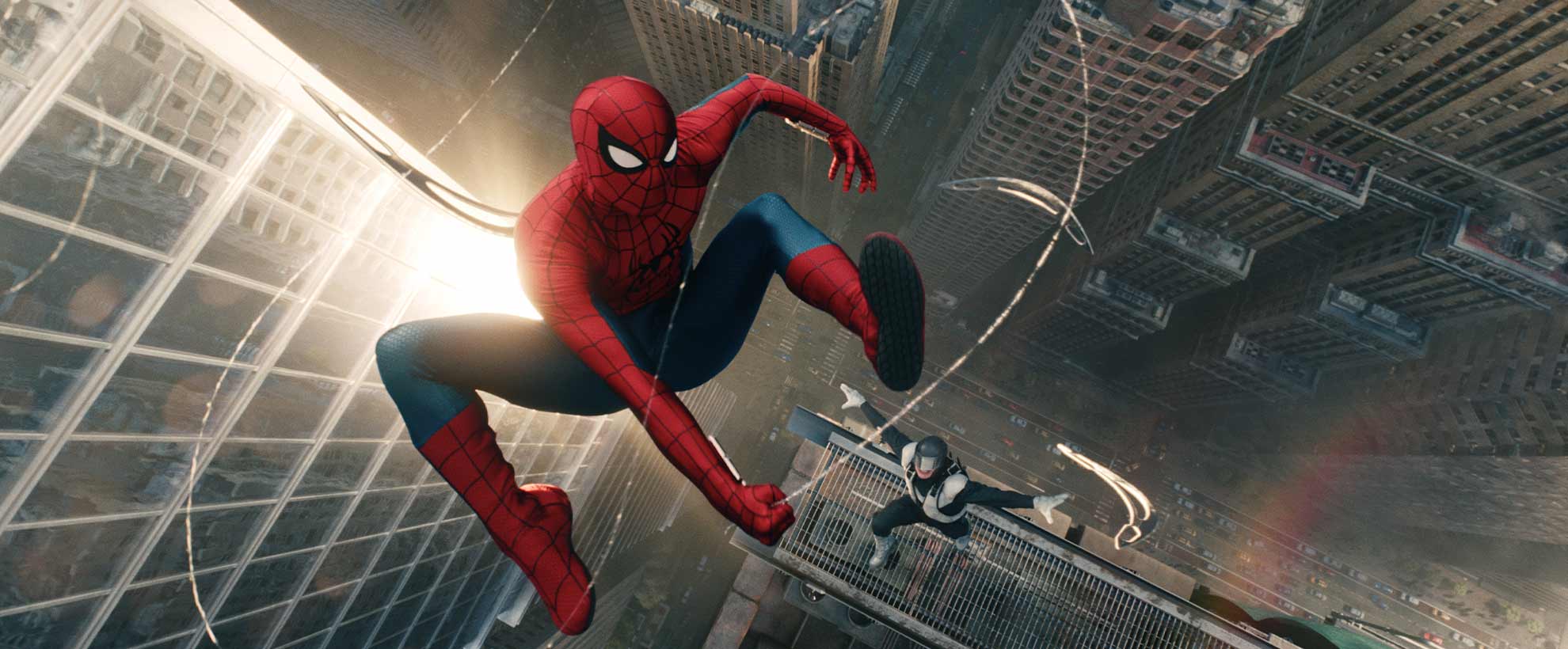
Believing MJ to be in danger, Peter races across New York City as Spider-Man, swinging from building to building to reach her side. Jean Grey possesses multiple bystanders as he swings past, using them to taunt him. Framestore Pre-production Services (FPS) worked extensively on the sequence, mapping out Parker’s route in previs using real New York City data. “We used digital scouting tools like Maya and real-time models to explore the city layout, factoring in accurate sun paths and time of day for lighting references,” explains Visualisation Supervisor Chris McDonald. “We had to make several minor adjustments like adding skyscrapers where none existed, as we needed to give Peter Parker something to swing from to propel him forwards in his frantic journey.”
Fairly new to his organic web powers, Spider-Man swings somewhat clumsily across the landscape. For the most part, the camera sticks with him, “we were aiming for a realistic feel reminiscent of drone or wire camera work,” comments McDonald. “For the next steps, we created techvis for both live-action stunts involving the real actor on a wire, and fully CGI shots. The techvis also provided necessary details, such as camera height and movement speed, for drone photography to accurately shoot backgrounds, with the camera height being around a few hundred feet.”
The team’s largest challenge creatively was selling the central concept of Jean Grey's mind-jump powers. “It’s very easy to find yourself leaning into comedy with powers like these, but the true nature of the ability is quite sinister. We collaborated with Framestore’s visual development team to come up with something that struck the right balance.”
Pride Comes Before A Fall
Thinking he had reached MJ in time, Peter stands with her on a rooftop and pours out his heart to her. “We techvis’d this sequence heavily, as it was set during the blue hour of sunset,” says McDonald. “We used Unreal to map the sun’s path and set the direction and tone of the lighting.”
The sweet moment turns sour as it is revealed that MJ has been possessed by Jean Grey since Peter’s arrival on the rooftop, their heartfelt reunion is instead a cruel ruse. Grey compels MJ to jump off the roof, leading to a slow-motion shot of Peter’s attempt to save her. “The sequence evolved from a quick-cut style to a more stylized, slow-motion approach” Chris notes.
Talk to The Hand
The fourth film in Tom Holland’s Spider-Man series is a stunt-heavy affair. During the third act, Jean Grey attempts to stop Parker reaching her by possessing a small army of ninjas known as The Hand. An intricate fight sequence ensues in a vertical cylindrical chamber, utilising the height in the tall, narrow space to make a dynamic dance between Spider-Man and his assailants. “We created digital doubles for Spider-Man and The Hand,” explains Bob Winter. “The Hand move as a unit, it’s all very choreographed, and so having half a dozen stunt-people on wires simultaneously would have been dangerous to shoot, as well as being a time-consuming matte painting job to remove the wires. By doing some shots with full digital doubles, we were able to get the exact movements we needed, and seamlessly integrate them with the rest of the scene.”

It's a BRAND NEW DAY for Peter Parker. Fighting crime full-time as Spider-Man in a world that doesn’t remember him—and the pressure of seeing his old friends move on without him—sparks a change in Peter he may not have the power to control. But that transformation might also be the only thing that can stop a shocking new threat to the city and those he loves - a powerful villain no one can even see. The world may have forgotten Peter Parker, but he hasn’t forgotten them.
Directed by Destin Daniel Cretton. Written by Chris McKenna & Erik Sommers. Based on the MARVEL Comic Book by Stan Lee and Steve Ditko. Produced by Kevin Feige, p.g.a., Amy Pascal, p.g.a., Avi Arad, and Rachel O'Connor, p.g.a. Executive Producers are Louis D'Esposito and David Cain. The film stars Tom Holland, Zendaya, Sadie Sink, Jacob Batalon, Jon Bernthal, Tramell Tillman, Michael Mando and Mark Ruffalo.
Spider-Man: Brand New Day released globally from 30 July 2026.
Credits
Related Case Studies
Spider-Man: No Way Home
Spider-Man: Far From Home